
Many companies already have enough software. Sales has CRM. Finance has accounting systems. Operations has ERP. HR has its own platform. Management has dashboards.
The problem starts when work needs to move across those systems.
A customer order may begin with sales, move to finance for payment terms, reach operations for fulfillment, trigger inventory updates, create billing records and return to customer service for follow-up. Each team may do its own part well, while the full workflow still becomes slow, unclear or hard to trace.
This is why workflow orchestration is becoming important. The value is not adding another layer of automation. The value is making cross-system work visible, accountable and easier to control.
The Problem Starts When Work Moves Across Teams
Most enterprise software is built around functions. CRM manages customer relationships. ERP manages operational and financial records. HR systems manage people data. Reporting tools show outcomes.
Business execution rarely stays inside one function.
Take a simple order-to-cash flow. A deal closes in CRM, but the real work is only beginning. Finance needs to check payment terms. Operations needs the delivery scope. Inventory needs to confirm availability. Billing needs the correct invoice data. Customer service needs to know what was promised.
When those steps are handled through scattered messages, manual updates or informal team knowledge, the workflow loses context every time it moves.
The symptoms are familiar:
Teams ask for information that already exists somewhere else.
Managers cannot see where a request is stuck.
Approvals depend on individual follow-up instead of clear rules.
Exceptions are handled outside the system.
Reports show delays, but not the step that caused them.
Camunda’s 2025 State of Process Orchestration and Automation Report surveyed 800 senior IT decision-makers, business decision-makers and enterprise software architects. The report found that 82% of organizations fear “digital chaos” as processes become more complex, interconnected and automated.
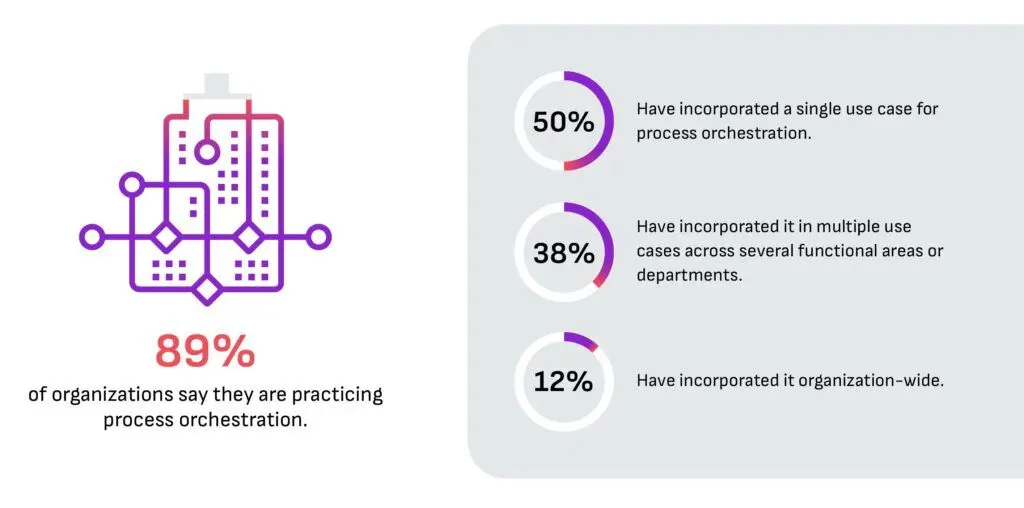
Process orchestration is already being adopted by many organizations, but most are still applying it to limited use cases rather than across the entire business. This shows why enterprises need to move from isolated workflow fixes to a more connected operating model. (Source: Camunda)
That concern is not only about having too many tools. It is about losing control over how work actually moves.
Automation Fails When Ownership and Exceptions Are Unclear
A common mistake is to automate isolated steps before the full workflow is understood.
A company may automate purchase requests, but still handle budget exceptions manually. It may automate customer ticket routing, but still lose context when the issue moves from support to operations. It may automate approvals, but leave unclear who owns non-standard cases.
Automation can make a broken workflow move faster without making it more reliable.
The real design questions are more basic:
Who owns each step?
Which data source should be trusted?
Which approval rule applies?
What happens when data is missing?
Which exception needs human review?
Which system should be updated after the decision?
How can the business prove what happened later?
This is where business workflow orchestration becomes useful. It gives the organization a shared operating path for tasks, approvals, systems and exceptions.
The point is not to remove every human decision. Many workflows still need judgment. The point is to make ownership and handoffs explicit enough that work does not depend on memory, personal follow-up or hidden workarounds.
A procurement workflow is a good example. An employee submits a request. The department head approves based on budget. Finance checks policy. Procurement works with the vendor. Accounting receives the invoice. If the request exceeds a threshold, it may need another approval. If the vendor is new, compliance may need to review it.
Without orchestration, each exception becomes a side conversation. With orchestration, the exception has a defined path.
Workflow Orchestration Creates a Shared Operating Path
Workflow orchestration connects the steps that sit between applications. It defines how work moves from request to decision to execution.
A good orchestration layer should connect five things:
Tasks: what needs to be done next.
People: who owns the step or approval.
Systems: where the data should be read or updated.
Rules: what conditions determine the next action.
Exceptions: where non-standard cases should go.
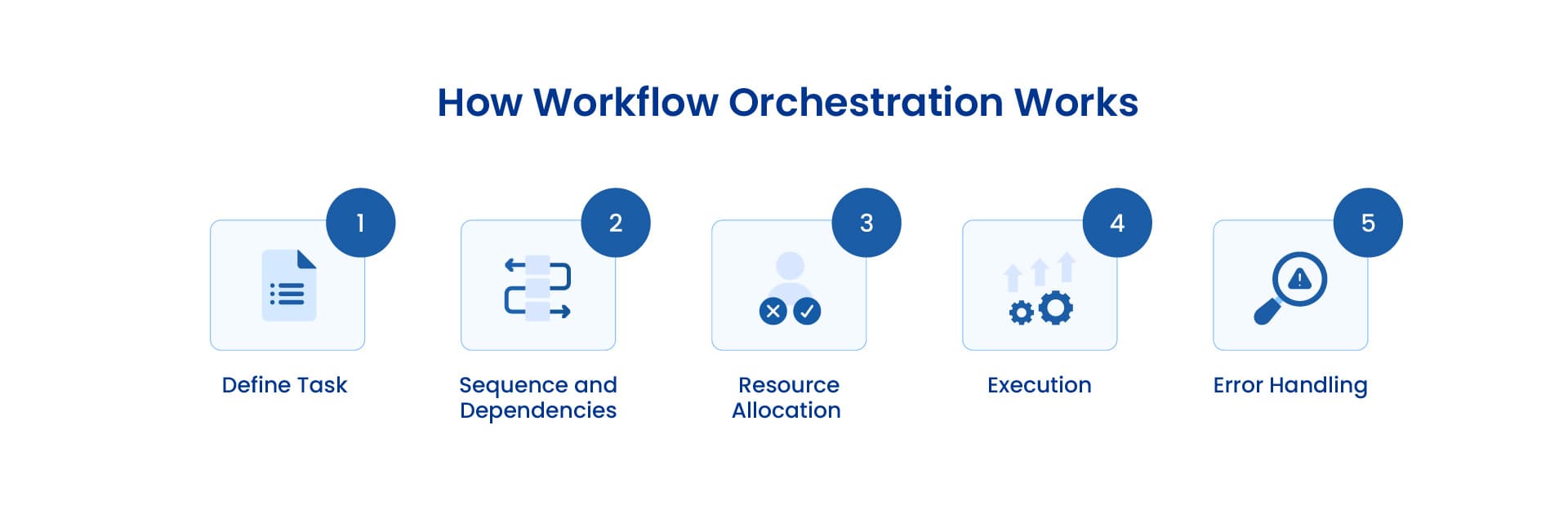
Workflow orchestration organizes work by defining tasks, sequencing dependencies, assigning resources, executing steps and handling errors. In enterprise operations, this structure helps make cross-system workflows easier to track and control. (Source: Astera Software)
This matters because enterprise work usually crosses several systems. The workflow layer should know when to pull data from CRM, when to update ERP, when to notify finance, when to wait for approval and when to escalate.
Gartner describes business orchestration and automation technology platforms as tools that unify process orchestration, connectivity and agentic features to support enterprise-wide automation.
That definition is useful because it places orchestration between systems and execution. It is not only a workflow diagram. It is the control layer that helps applications, data and people work in the right order.
For example, in a customer refund workflow, orchestration can check the order record, verify payment status, route approval based on refund amount, notify the customer service team and update finance after completion. The system does not just “automate a task.” It keeps the full process traceable.
That traceability is often what executives need most. They do not only need to know whether work is done. They need to know where work is delayed, who owns the next step and which exceptions are slowing the business down.
AI Makes Workflow Discipline More Important
AI adds a new layer to this problem.
AI assistants and agents can summarize records, classify requests, prepare responses, recommend next steps and call tools. In stronger use cases, they may also help trigger actions inside business systems.
That makes workflow discipline more important, not less.
An AI agent supporting customer service needs to know which customer data it can read, which refund actions it can suggest, which actions need approval and which system should be updated after the decision. An AI assistant supporting finance needs to understand approval thresholds, exception rules and audit requirements. An AI workflow supporting operations needs to know when it can act and when it must escalate.
Deloitte’s AI Institute describes AI agents as a shift in business process automation, where agents can work with people and systems to support more adaptive operations. That potential is real, but it depends on the quality of the workflow around the agent.
AI does not fix unclear process ownership. It can make unclear ownership more dangerous.
A practical AI-enabled workflow should define:
Which data AI can access.
Which tools AI can use.
Which actions AI can recommend.
Which actions AI can execute.
Which steps need human approval.
How every AI-assisted step is logged.
This is where Twendee usually starts from the operating flow instead of the AI feature. Before adding AI into a process, the workflow needs clear data sources, approval logic, exception handling and system integration. Once that structure exists, AI can support execution without creating a new layer of uncontrolled activity.
Start With the Workflow Before Choosing the Tool
Many workflow projects start with software selection. That is often too early.
The better starting point is the workflow itself. A company should first map how work moves today, where context is lost and which exceptions create the most delay.
A useful workflow review should answer:
Where does the request begin?
Which teams touch it?
Which systems hold the required data?
Which steps depend on approval?
Which exceptions happen most often?
Which handoffs create delays?
Which decisions need an audit trail?
Which metrics show whether the process is improving?
Workato’s enterprise agentic AI research notes that many organizations are implementing enterprise orchestration to close the trust gap between AI investment and adoption. The underlying lesson is relevant beyond AI: orchestration becomes valuable when systems, people and decisions need a shared operating structure.
The metrics should also reflect the workflow, not only the software.
A mature workflow view should track:
Cycle time from request to completion.
Approval delay by role or department.
Number of handoffs per workflow.
Exception rate by process type.
Rework caused by missing data.
Escalation volume and resolution time.
Automation rate by workflow step.
These metrics help the business improve the workflow after it goes live. They also show where automation or AI would actually create value.
Twendee’s role is to help businesses map these workflows across departments, connect workflow steps with ERP, CRM and internal tools, and design approval logic, exception routing and operational dashboards. The goal is not to create a more complex system. The goal is to make business execution easier to see, manage and improve.
Conclusion
Enterprise workflows usually break between systems, teams and approvals. A company may have strong software inside each department, while the work that crosses departments remains slow, unclear and difficult to trace.
Workflow orchestration creates the shared operating path between applications, data and business execution. It makes ownership clearer, handoffs cleaner and exceptions easier to manage.
As automation and AI move deeper into operations, workflow discipline becomes even more important. Twendee helps businesses map workflows, connect systems and design the approval logic, exception routing and dashboards needed for reliable execution.
Book a call: Calendly
Read our latest blog: AI Is Changing Which Enterprise Applications Get Modernized First
