

Most companies do not run on one system anymore. A sales team may work in a CRM. Finance manages invoices in accounting software. Operations tracks delivery or implementation elsewhere. HR has its own platform. Management uses dashboards that depend on data from all of these places. On paper, each system has a clear purpose. In daily operations, the problem starts when these systems cannot move together.
A customer update in sales may not reach finance in time. A payment issue may not be visible to the account owner. A project status may change in an internal tool but stay outdated in management reporting. The company has more software, but the work still depends on people checking, copying, asking, and confirming information across teams.
That is why an enterprise integration platform has become a strategic investment. The goal is no longer simply to connect one application to another. The bigger goal is to keep data, workflows, and business decisions moving through the company without every handoff becoming manual work.
More Applications Create More Operational Gaps
Enterprise software ecosystems have grown faster than most companies’ ability to connect them. MuleSoft’s 2025 Connectivity Benchmark found that organizations use 897 applications on average, yet only 2% of businesses have integrated more than half of their applications. That gap matters because every disconnected application becomes another place where data can become delayed, duplicated, or inconsistent.
This is where software growth starts to create operational drag.
A CRM may show that a customer is ready to renew, while the finance system shows unpaid invoices. A support platform may contain unresolved complaints that the sales team has not seen. An internal project tool may show delivery delays that are not reflected in the customer success dashboard. No single team is necessarily doing anything wrong. The issue is that each team is working from a different part of the truth.
As the number of systems grows, employees often become the “integration layer” inside the company. They copy data between tools, ask for screenshots, check spreadsheet versions, and confirm updates through chat. These small actions look harmless when viewed one by one. Across hundreds of workflows, they become a hidden cost of scale.
This is why enterprise integration cannot be treated as a cleanup task after software adoption. Once a company reaches a certain level of complexity, integration starts shaping how fast the business can respond, how reliable its reports are, and how confidently teams can act on data.
The Real Cost of Disconnected Systems Appears Inside Workflows
The cost of disconnected systems rarely appears as one obvious failure. It usually shows up inside everyday workflows.
Take a sales-to-finance process. A customer agrees to a new package. Sales updates the CRM, but finance still waits for contract details. Finance then needs to verify pricing, billing terms, tax information, and payment status. Operations may need to prepare onboarding, but the final confirmation has not reached their system. Management later checks revenue progress, but the dashboard only reflects part of the process.
The delay is not caused by one weak tool. It comes from the empty space between tools.
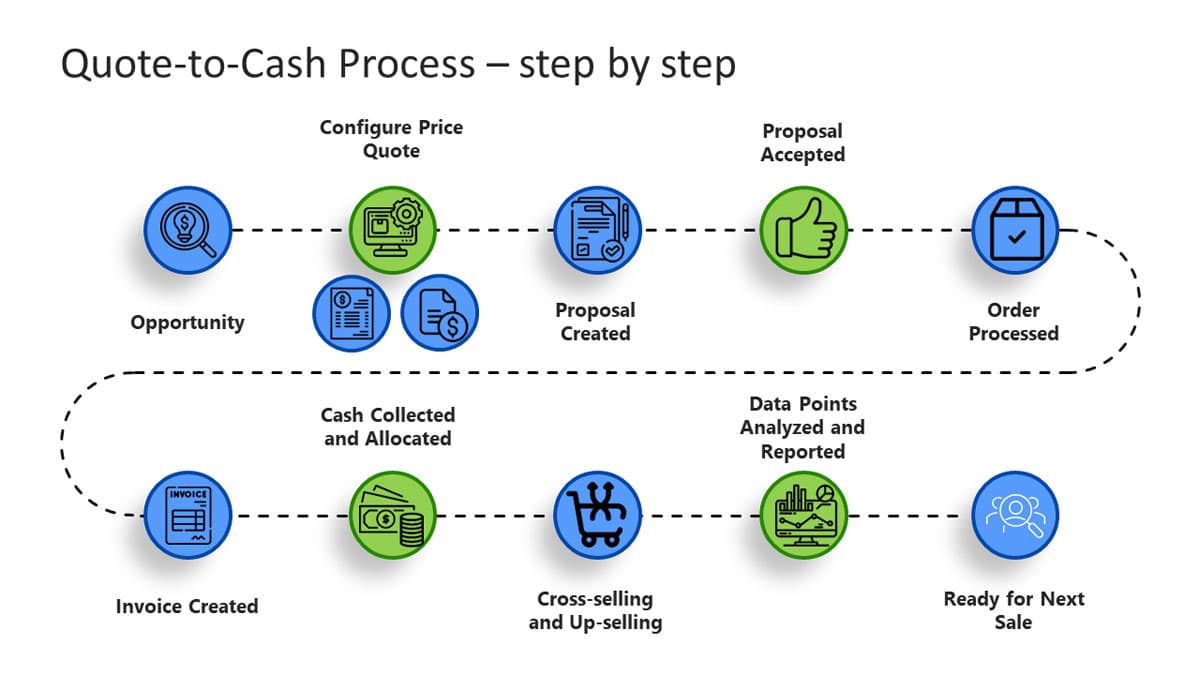
The quote-to-cash process depends on connected handoffs across sales, pricing, order processing, invoicing, payment collection, and reporting. (Source: servicePath)
That empty space creates three problems for the business.
Repeated manual work: Employees spend time moving data, checking whether information is correct, and asking other teams for updates that should already be available.
Weak data consistency: When the same customer, invoice, order, or request appears differently across systems, teams lose time deciding which record to trust.
Limited flexibility: A company cannot easily automate or improve a workflow if the workflow depends on disconnected data and informal handoffs.
This is the point where integration becomes a business capability. A well-designed integration layer gives the company a clearer way to move information between systems, define which source owns which data, and reduce the manual steps that slow down cross-functional work.
In other words, the value of integration is not only technical. It shows up in fewer delays, fewer duplicated records, cleaner reporting, faster handoffs, and workflows that can keep working as the business adds more products, markets, teams, or systems.
Integration Platforms Are Becoming the Foundation for Scale
The market is already moving in this direction. Gartner reported that the worldwide integration platform as a service market grew 23.4% to $8.5 billion in 2024, driven by SaaS adoption, AI, and low-code or no-code development tools.
That growth reflects a practical shift. Companies are moving away from integration as a series of one-off connectors. A quick connection between two systems may solve an immediate issue, but it often becomes hard to maintain when more applications, teams, and workflows are added.
An enterprise integration platform gives businesses a more reusable foundation. Gartner defines integration platform as a service as a vendor-managed cloud service that enables integrations between applications, services, and data sources across internal and external systems. Gartner also describes three key patterns: data consistency, multistep processes, and composite services.
Those three patterns are useful because they describe what integration needs to achieve at the business level.
Data consistency helps teams work from records that stay aligned across systems. If payment status changes, the right teams should not need to wait for someone to manually update three separate tools.
Multistep processes allow workflows to move across departments. A customer onboarding process may need sales confirmation, finance review, operations setup, support preparation, and customer success follow-up. Integration allows these steps to move through connected systems rather than disconnected messages.
Composite services make integration more scalable. Instead of rebuilding the same logic for every new project, companies can reuse approved data flows, APIs, and service layers across multiple workflows.
This is why an enterprise integration platform becomes part of operating architecture. It gives the company a way to add new applications without multiplying manual work. It also creates a stronger foundation for future digital initiatives because new systems can connect into an existing structure instead of starting from zero.
AI Raises the Standard for Integration
AI makes this issue more urgent because AI needs connected context to support real business work.
Many companies are experimenting with AI agents, copilots, and automated workflows. These tools can summarize, draft, recommend, and answer questions. However, an AI system that only sees one application cannot understand the full operating context of a business process.
MuleSoft’s 2026 Connectivity Benchmark found that 50% of AI agents currently operate in isolated silos, while 96% of IT leaders agree that AI agent success depends on seamless integration. The report also notes that 86% of IT leaders believe agents can create more complexity than value without proper integration.
This data matters because it explains why many AI initiatives struggle to move beyond isolated use cases.
An AI agent helping sales needs more than CRM notes. It may need pricing rules, contract terms, support history, payment status, product usage, and approval logic. An AI agent supporting operations may need order status, inventory, delivery timeline, resource availability, and exception rules. An AI agent supporting finance may need budget limits, invoice data, approval workflows, and audit records.
If those systems remain disconnected, AI becomes another tool employees must feed manually. It may produce useful answers, but it cannot reliably support a workflow from start to finish.
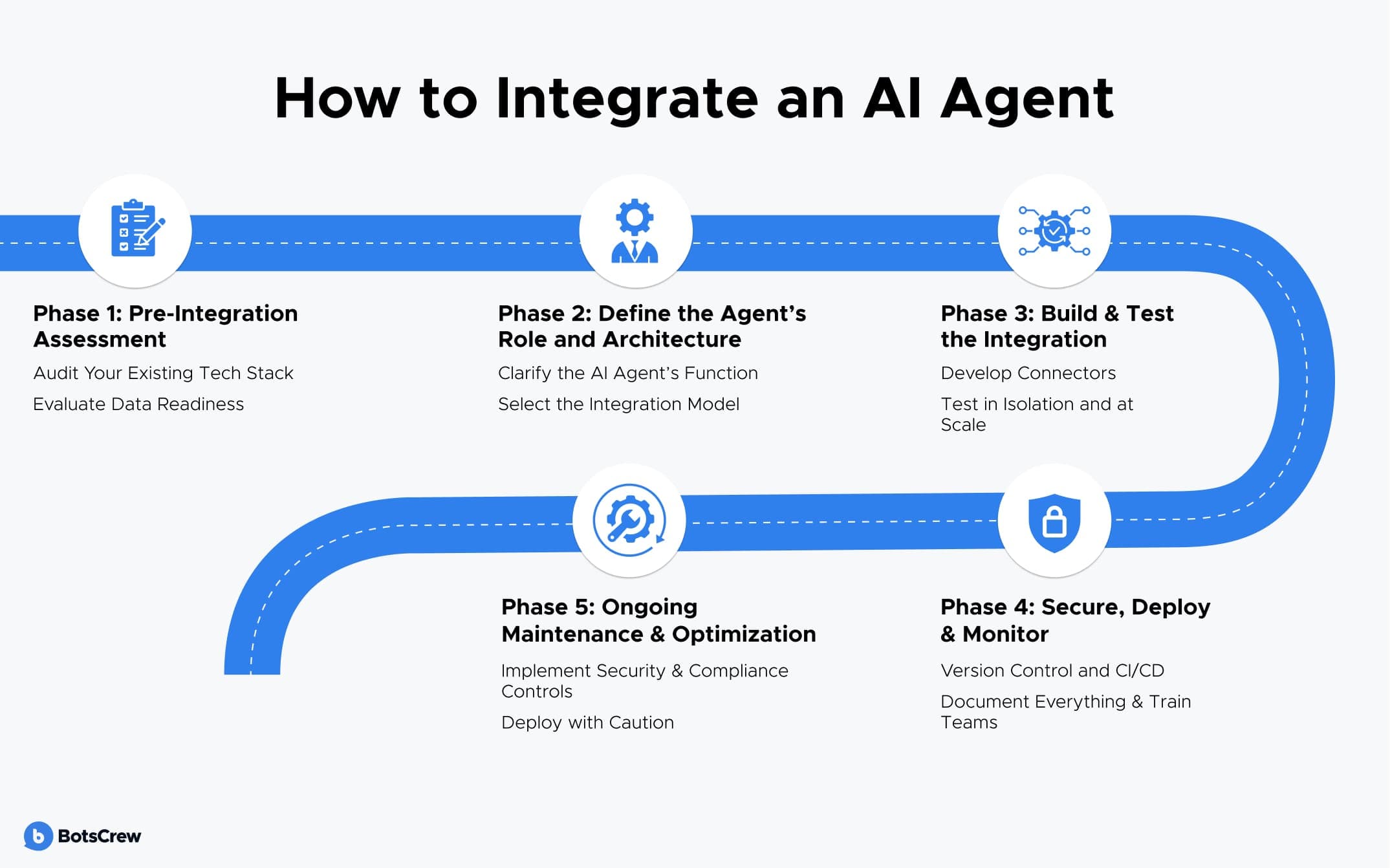
Integrating an AI agent into enterprise operations requires more than model selection. Businesses need to assess their existing systems, evaluate data readiness, define the agent’s role, build connectors, and set up security, testing, deployment, and monitoring before AI can support real workflows. (Source: Botscrew)
The next phase of enterprise AI will depend less on how impressive the interface looks and more on whether AI can work with trusted data, trigger actions in the right systems, respect access permissions, and leave a clear record of what happened. All of that depends on integration.
So AI does not reduce the need for enterprise integration. It makes integration more important because AI increases the cost of fragmented data and disconnected workflows.
How Twendee Helps Businesses Build Integration That Fits Real Workflows
For many companies, the difficult part is not deciding that integration matters. The harder part is knowing where to start.
Trying to connect every system at once can make integration projects too large and too abstract. A more practical approach is to begin with the workflows where disconnected systems create the most visible friction. That may be sales-to-finance handoff, customer onboarding, order tracking, approval workflows, reporting, internal requests, or support operations.
Twendee helps businesses design integration architectures around these real operating flows. This can include connecting ERP, CRM, finance platforms, internal tools, and custom applications; designing APIs; synchronizing data; and building workflow automation that can support future digital or AI initiatives.
The focus is on building an integration layer that matches how the company actually works. When data ownership, system connections, and workflow logic are designed clearly, each new application or AI use case does not need to rebuild the foundation from the beginning.
That is how integration becomes a long-term capability rather than another short-term technical project.
Conclusion
Enterprise integration has become a strategic investment because disconnected systems create real operational costs. They slow handoffs, weaken data consistency, increase manual work, and make automation harder to scale.
An enterprise integration platform gives businesses a stronger foundation for cleaner data flows, more reliable cross-functional workflows, reusable APIs, and better readiness for AI. As companies continue adding SaaS tools, custom systems, and AI initiatives, integration will play a larger role in how well the business can scale.
This is also where Twendee supports enterprise teams: by designing integration architectures that connect ERP, CRM, finance platforms, internal tools, and custom applications around real business workflows. When integration is built as operating infrastructure, companies can move faster, adapt systems more easily, and turn future digital initiatives into measurable business value.
Book a call: Calendly
Read latest blog: Process Ownership Becomes Harder as Organizations Scale
