
Bank reconciliation often looks simple when transaction volumes are low: compare the bank statement with the ledger, identify differences, make the necessary adjustments and move on.
That changes quickly as the business grows. More bank accounts, entities, currencies, payment channels and transaction sources create far more combinations to reconcile. At that point, bank reconciliation software is no longer just a productivity tool. It becomes part of the financial control environment.
The key question for finance leaders is therefore not simply how much a platform can automate. It is whether the system can match transactions reliably, surface meaningful exceptions and connect reconciliation with the wider close process.
Bank Reconciliation Becomes Harder as Transaction Complexity Grows
Manual reconciliation can work surprisingly well in a simple environment. A finance team managing a small number of bank accounts and predictable transaction types may be able to compare records in spreadsheets without creating significant operational risk.
Scale changes the nature of the work.
Imagine a business that collects payments through several channels, operates multiple legal entities and works with more than one banking partner. One bank deposit may represent dozens of customer transactions. Settlement dates may differ from invoice dates. Fees may be deducted before funds arrive. Foreign exchange creates further variations between expected and actual amounts.
The finance team is no longer asking whether two ending balances are equal. It is trying to understand which transactions belong together and why some do not.
This is why reconciliation complexity tends to grow faster than transaction volume alone. Each additional account, entity and data source introduces another relationship that finance must explain.
The problem is visible in real-world deployments. Australia Post, for example, was managing thousands of subsidiaries and accounts while its finance team relied on a slow, manual close process. Following reconciliation and transaction-matching automation, its environment was processing roughly 750 reconciliations and 500,000 matches each month, according to a published BlackLine customer case study. Casestudies
At this scale, reconciliation becomes an operational control problem. Finance needs a consistent method for deciding which transactions can be cleared automatically, which require investigation and which indicate a wider data or process issue.
The Real Test of Reconciliation Software Is Transaction-Level Matching
A balance comparison can confirm that something is wrong. It rarely explains what is wrong.
That distinction matters when evaluating reconciliation software. Enterprise-grade reconciliation has to work at the transaction level, comparing records across bank feeds, ERP systems, subledgers and accounting platforms.
The matching logic also needs to reflect how money actually moves through the business.
A straightforward payment may be matched using amount, date and reference number. Other scenarios are more complicated. Several invoices may be settled by one payment. One transaction may appear across several settlement records. Dates may differ by a few days, or amounts may fall within an accepted tolerance because of fees or foreign exchange.
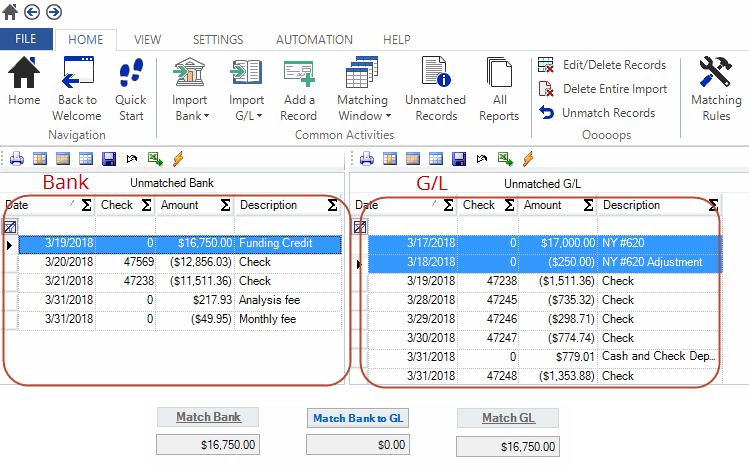
Bank reconciliation software matching bank transactions against general ledger records and identifying unmatched items (Source: Bank Reconciliation)
This is why configurable matching rules are more valuable than a simple “auto-match” feature. Oracle, for example, supports matching rule sets with tolerance rules as well as one-to-one, many-to-one and many-to-many transaction relationships within its reconciliation products. Its documentation also provides dedicated workflows for reviewing reconciliation exceptions. Oracle Docs
The practical lesson for finance teams is important: an impressive automation percentage says little unless the logic underneath it is reliable.
SiriusXM offers a useful example. Its automated process imports transactions and matches them against the appropriate journal or subledger records. BlackLine reports that the company achieved 99.9% matching accuracy through this approach. blacklinesystems
The strongest reconciliation systems therefore do more than create matches. They make the basis for those matches understandable and leave uncertain records visible for review.
A reconciliation process is only as trustworthy as the logic behind every transaction it clears.
Exception Management Determines Whether Automation Actually Saves Time
Successful matches are rarely where finance teams spend most of their time.
The real workload sits in the exceptions.
A missing payment reference, partial settlement, duplicate transaction, unexpected bank fee or timing difference can prevent an otherwise straightforward reconciliation. When these records accumulate, automation may simply produce a long list of transactions that people still need to investigate manually.
This is why exception management is a better test of bank reconciliation automation than the raw number of transactions automatically matched.
The objective should be to reduce how many transactions people have to touch while making the remaining cases easier to resolve.
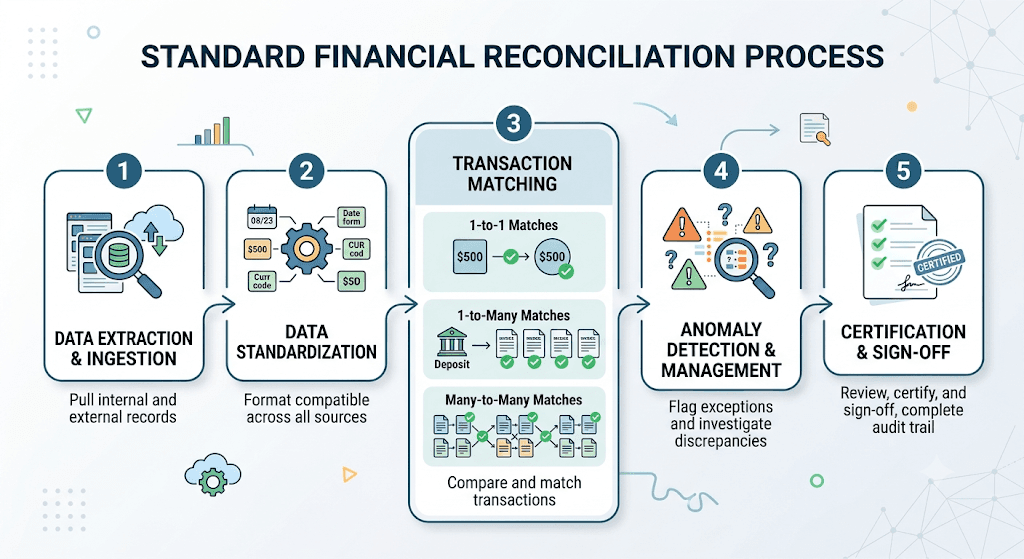
Financial reconciliation workflow showing transaction matching, exception detection and management, and final certification (Source: High Radius)
That requires more than flagging an unmatched record. The workflow needs enough context to help someone understand the issue, clear ownership over who should investigate it, and a record of what happened next. In more controlled environments, approval and escalation may also be required before an adjustment can be posted.
The difference can be significant. Trintech reports that Bangor Savings Bank reduced manual reconciliation work by 80%, while another of its banking deployments, Metro Bank, has processed more than one million transactions per day with match rates around 99%. Trintech
Those numbers are useful, but the broader lesson is more important. High-volume automation creates value when it leaves finance teams with a smaller and more meaningful population of exceptions.
This also changes the role of the finance professional. Instead of repeatedly comparing rows of data, people spend more time investigating unusual transactions, resolving root causes and strengthening the controls around recurring problems.
The better measure of reconciliation automation is therefore not “How many transactions did the system process?” but “How much unnecessary human investigation did it remove?”
Enterprise Reconciliation Depends on Integration, Control and Close Readiness
Transaction matching cannot deliver its full value in isolation.
If bank data is automatically matched inside one platform but finance still has to export results, update the ERP manually and maintain a separate spreadsheet for unresolved items, the organization has automated one task while leaving the wider process fragmented.
Enterprise reconciliation needs to connect bank feeds, accounting records, review workflows and financial reporting.
That connection becomes particularly important in multi-entity environments. Different entities may use different accounts, currencies or accounting structures, yet finance leadership still needs consistent visibility across the group. Audit requirements add another layer: teams need to know which records were matched automatically, which were adjusted manually, who approved an override and which exceptions remain unresolved.
This is where audit history and ERP connectivity become just as important as the matching engine itself.
The connection to financial close is equally important.
An unmatched transaction is not merely a reconciliation status. Depending on the account and value involved, it may affect the organization's readiness to close the period.
Reconciliation reporting should therefore help finance leaders see more than completion percentages. They need visibility into unresolved transactions, aging exceptions, reconciliation status and whether outstanding items create material risk for the close.
This is already becoming part of the broader financial-close automation model. Oracle integrates account reconciliation with its Financial Consolidation and Close environment, while reconciliation adjustments can be posted back into cloud or on-premises ERP systems. Oracle
The underlying idea is simple: reconciliation becomes more valuable when it tells finance teams not only what remains unmatched, but whether those exceptions matter to the close.
For Twendee, this is also where technology implementation extends beyond selecting a reconciliation product. In practice, enterprises may need to connect bank feeds with existing ERP and accounting systems, translate financial policies into matching rules, design exception workflows and build reporting around unmatched transactions and close readiness.
The software provides capabilities. The surrounding workflow determines whether those capabilities become part of an effective finance operation.
Choosing Bank Reconciliation Software Should Start With Your Transaction Environment
This is why finance teams should resist selecting a platform primarily by comparing feature lists.
The right solution depends on the transaction environment it needs to support.
A company processing a few thousand predictable bank transactions every month has very different requirements from a group operating across multiple entities, payment platforms and banking partners. Even organizations of a similar size may have entirely different reconciliation workloads.
Three questions tend to reveal more than a long software checklist:
How complex are the relationships between bank transactions and accounting records?
How many exceptions still require human judgment?
How easily can reconciliation connect with the systems and controls already used by finance?
Transaction volume still matters, but volume alone does not determine complexity. One million clean one-to-one transactions may be easier to automate than a smaller population involving aggregated settlements, partial payments and inconsistent references.
The same principle applies to automation targets. A platform promising the highest theoretical match rate may be less useful than one that can support the organization's actual matching logic and make unresolved transactions easy to control.
Finance teams should therefore evaluate transaction matching software against their own operating model: bank-account structure, number of entities, transaction patterns, ERP architecture, exception workload and governance requirements.
This changes the buying question from “Which tool has the most automation?” to something more useful:
Which system can reliably support the way our financial transactions actually move, reconcile and close?
Conclusion
Bank reconciliation is becoming less about comparing balances and more about controlling transaction flows across increasingly complex financial systems.
The strongest bank reconciliation software combines transaction-level matching with disciplined exception management, ERP connectivity, auditability and visibility into the financial close. Automation matters, but only when it reduces manual work without weakening financial control.
For organizations dealing with fragmented bank feeds, complex matching logic or growing reconciliation workloads, Twendee can help design and integrate reconciliation workflows around existing ERP and accounting environments, from transaction matching and exception handling to close-ready reporting.
Visit the Twendee website, follow Twendee on LinkedIn, or book a conversation through Twendee’s Calendly to explore how your current reconciliation process could be simplified, integrated and automated without losing the controls finance teams depend on.