
For years, build vs buy software was treated as a sourcing question: how fast can the company deploy, how much will it cost, and does the engineering team have capacity? AI has made that logic incomplete. Software choices now determine how easily a business can connect data, redesign workflows, automate operations, and control strategically important capabilities.
Why Build vs Buy Has Become a Strategic Decision Again
The old decision model assumed that software primarily supported an existing process. A company could buy a standard product, configure it, train users, and measure success through adoption and cost savings. Custom software development was usually reserved for requirements that commercial platforms could not meet.
That boundary is becoming less useful. AI-native products are entering every software category, APIs are turning applications into interconnected services, and enterprise data is becoming a core input for automation. Digital workflows increasingly shape how a company serves customers, manages risk, prices products, and responds to operational change.
The scale of AI adoption explains why this question has returned to the executive agenda. McKinsey’s 2025 State of AI survey found that 88% of respondents said their organizations used AI regularly in at least one business function, yet only about one-third had begun scaling AI across the enterprise. The gap suggests that access to AI is no longer the main constraint. The harder issue is whether the company’s systems, data, and workflows can support it at scale.
A software decision can therefore accelerate or restrict future operating choices. Leaders must consider more than whether a product meets today’s requirements. They also need to know whether the architecture will let the business change how work is done two or three years from now.
AI Is Redefining What Enterprise Software Must Do
Traditional enterprise software was designed around records and transactions. A CRM stored customer activity. An ERP managed orders, inventory, and finance. A ticketing platform routed service requests. AI introduces a different expectation: software must help interpret context, coordinate decisions, and trigger action across multiple systems.
That requires more than adding a chatbot to an existing interface. An AI system needs access to trusted internal data, permission-aware connections to business applications, and a clear path from model output to workflow execution. It may need to retrieve a contract, check an order in the ERP, compare a service-level agreement, draft a response, request approval, and update the CRM. The value comes from the complete operational loop rather than the model alone.
Integration has therefore become part of the product decision. According to the Salesforce 2026 Connectivity Report, enterprises now use an average of 957 applications, while only 27% are integrated. The same research found that 96% of IT leaders believe AI agent success depends on seamless data integration, and 94% expect enterprise architecture to become more API-driven.
This changes the role of enterprise software. A platform is valuable when it can exchange data, expose reliable APIs, support governance, and adapt to proprietary workflows. Software is moving from a place where information is stored to a layer through which the company applies intelligence to daily operations.
The Real Cost Is Moving From Acquisition to Architecture
The usual comparison between SaaS vs custom software begins with subscription fees on one side and development cost on the other. That comparison is easy to present in a budget meeting, but it captures only the visible entry price.
The larger cost often appears after implementation. A standard product may require middleware to connect with legacy systems, repeated customization as processes change, and extra tools to fill functional gaps. Data may be exportable but difficult to reuse because of inconsistent formats or limited access. AI capabilities may depend on the vendor’s roadmap, model choices, or permission structure. Each constraint introduces another layer of work.
A stronger evaluation asks:
What will it cost to integrate and operate this system over its full lifecycle?
How quickly can the architecture adapt when workflows, regulations, or AI capabilities change?
Which data, decisions, and processes will remain under the company’s control?
This is why the cheapest decision today can become the most expensive architecture tomorrow. A low-cost application that creates new data silos or manual handoffs can increase operating friction for years. A custom platform can also become expensive when it is poorly scoped, overengineered, or dependent on a small internal team. Neither buying nor building reduces risk by default.
The focus should move from upfront price to strategic option value: how many future choices does the architecture preserve, and how costly will change become?
Buy the Commodity. Build the Differentiation.
Buying creates the most value when the capability is already standardized and the market has solved it well. Payroll, accounting, collaboration, document storage, and common CRM functions rarely justify rebuilding from the ground up. Commercial platforms offer mature features, established security controls, regular updates, and faster deployment.
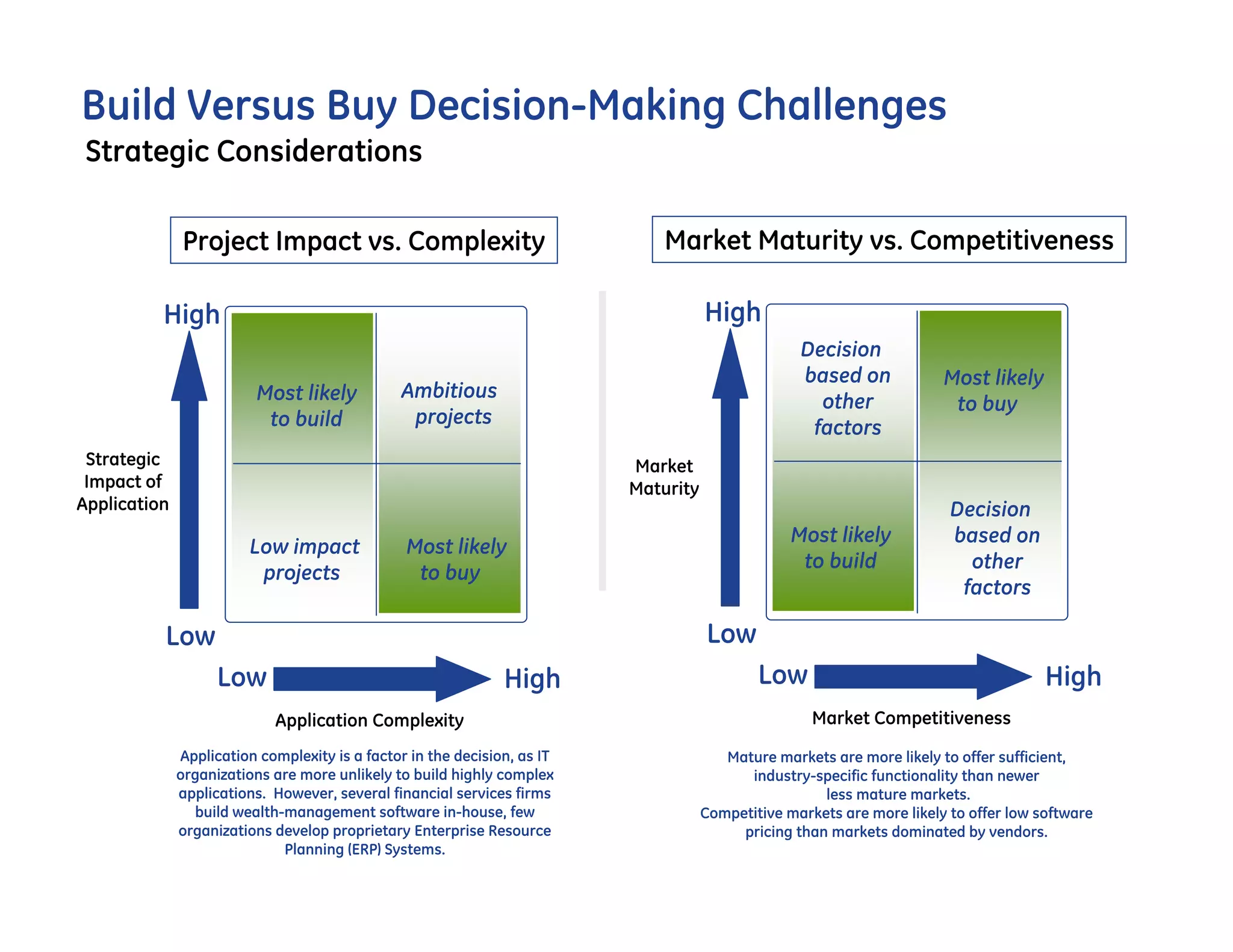
Build versus buy decision matrices comparing strategic impact, application complexity, market maturity and market competitiveness. (Source: Build vs Buy Strategy)
Building becomes more compelling when software shapes how the business competes. Proprietary workflows, operational intelligence, industry-specific processes, customer experience, and AI-powered internal operations can contain knowledge that a standard platform cannot fully represent.
Domino’s provides a clear example. The company has invested in digital ordering capabilities as part of its operating model rather than treating ordering as a generic software function. In fiscal 2025, Domino’s reported more than $20.1 billion in global retail sales, with over 85% of U.S. retail sales generated through digital channels. Its ordering platforms are closely connected to customer experience, franchise operations, and delivery economics.
The lesson is not that every company should build a customer platform. Domino’s built around a capability that directly affects revenue, convenience, and brand differentiation. For another business, the strategic layer may be pricing, fulfillment, risk assessment, production planning, or after-sales service.
This is where Twendee’s role fits naturally. The objective is to identify which capabilities existing products can handle and which workflows deserve greater ownership. Through its work across custom software, AI solutions, automation, ERP, and digital operations platforms, Twendee can help companies connect existing systems and develop the custom layers that support a distinct operating advantage.
Hybrid Architecture Is Becoming the Default Enterprise Strategy
In practice, the strongest enterprise software strategy rarely sits at either extreme. Companies are combining stable commercial platforms with custom data, workflow, integration, and AI layers. They may run a standard ERP while building a specialized operations layer, extend a CRM with an AI agent, or connect a collaboration suite to an internal knowledge platform.
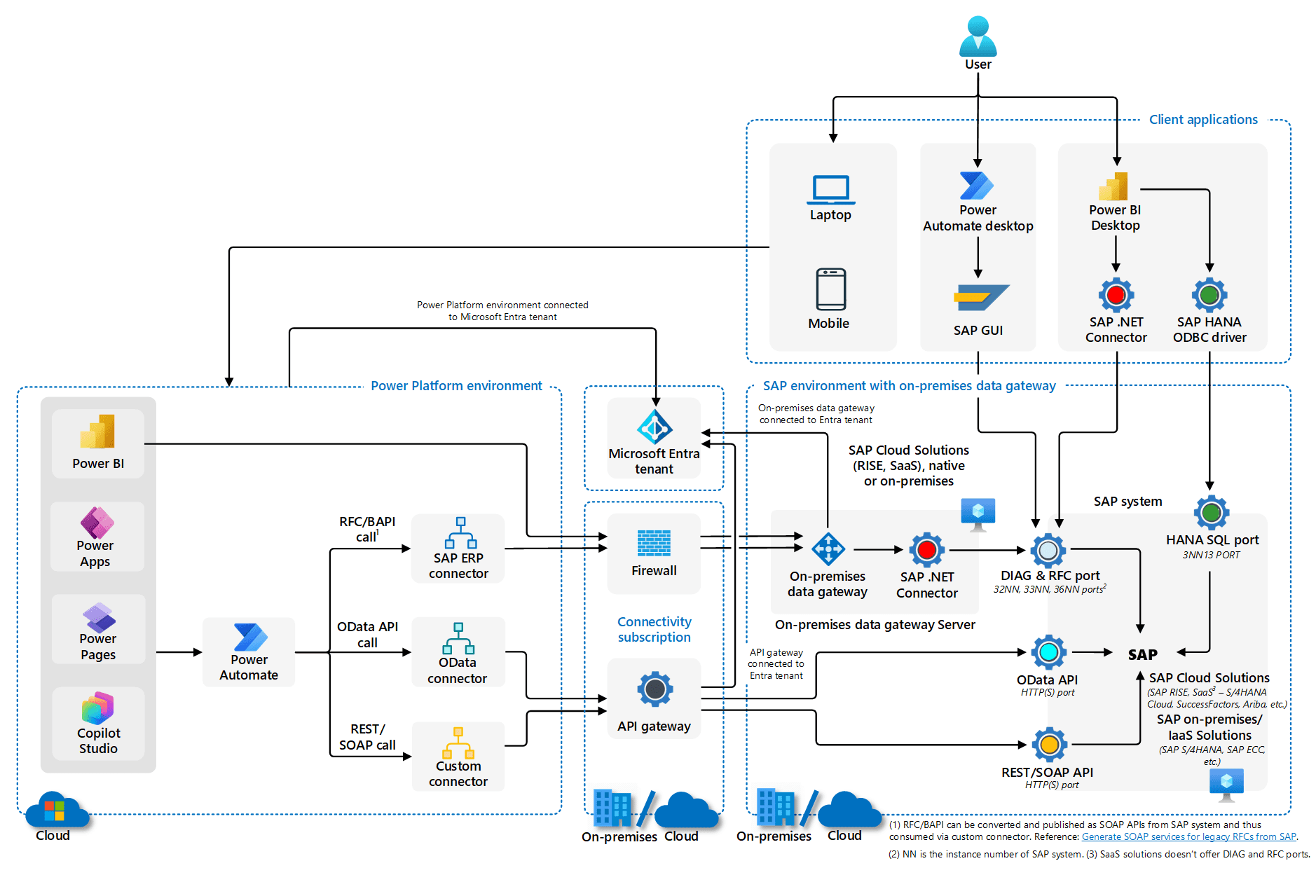
Hybrid enterprise architecture connecting SAP with Microsoft Power Platform, Power Automate, Power BI, Copilot Studio, APIs and on-premises data systems. (Source: SAP and Microsoft Power Platform Architecture Workflow.)
Morgan Stanley’s AI deployment shows how this approach can work. The firm used OpenAI technology, but embedded it within its own knowledge, controls, advisor workflows, and enterprise applications. Its AI assistant reached 98% adoption among Financial Advisor teams. A later meeting tool could generate notes, surface action items, prepare a draft email, and save the final record into Salesforce.
The strategic value came from the combination. Morgan Stanley did not need to create a foundation model. It did need to control how the model accessed intellectual capital, interacted with regulated workflows, and connected to the systems advisors already used. That is the logic of hybrid architecture: buy the mature foundation, then build the context and execution layer that reflects how the business operates.
This approach also preserves flexibility. Vendors can change, models can improve, and business processes can evolve without forcing the company to replace its entire technology estate. The architecture becomes modular enough to adopt new capabilities while protecting the data and workflows that carry strategic value.
Technology leaders are therefore moving beyond the question, “Should we build or buy?” The more useful questions are: Which capabilities should remain strategic? Where does the business need room to adapt? Which data, workflows, and decisions should the company own?
Conclusion
The build-vs-buy decision has moved from procurement into enterprise architecture. AI, integration complexity, and data ownership are making long-term flexibility as important as implementation speed and initial cost.
The answer may be buy, build, or a deliberate combination of both. What matters is whether the choice protects the company’s ability to adapt and keeps strategic capabilities under the right level of control. Visit the Twendee website, follow Twendee on LinkedIn, or book a conversation through Twendee’s Calendly.
