
Enterprise data rarely stays where it was created. A customer record entered in CRM may later shape a finance report, trigger an automated workflow, and provide context for an AI agent. As these dependencies multiply, enterprise data lineage, data traceability, and data lineage for AI are becoming more than governance capabilities. They help enterprises answer a more consequential question: when one piece of business data changes, what else changes with it?
Data Is No Longer Used in One Place - Its Impact Spans the Enterprise
Most business data now has a life beyond its source system.
An order may originate in ERP, customer information in CRM, and transaction data in a payment system. From there, the same information is copied, transformed, aggregated, and reused across data warehouses, BI platforms, internal applications, automated processes, and AI systems.
The complexity comes from dependency rather than volume alone.
LinkedIn encountered this problem at considerable scale when building DataHub. Its engineering team described a metadata graph containing more than one million datasets, 23 data storage systems, 25,000 metrics, and over 500 AI features. More importantly, LinkedIn identified relationships such as lineage and dependencies as first-class metadata because they enable functions including impact analysis. LinkedIn Engineering’s DataHub architecture
Most enterprises operate at a smaller scale, but the structural challenge is the same. A field such as customer status, payment condition, product category, or credit limit may appear to belong to one application while several other systems quietly depend on it.
This makes “Where is the data?” an incomplete question.
The more useful question is “What depends on this data?” — because the business impact of a data asset increasingly lies downstream from where that asset is created.
Data Lineage Makes the Business Dependency Chain Visible
Data lineage gives enterprises a way to reconstruct that chain.
Google Cloud’s guidance on data lineage defines lineage around the lifecycle of data: its origin, movement, transformations, and destinations such as reports, dashboards, or applications. Modern lineage can operate at several levels, from tables down to individual columns.
For business use, the important distinction is between knowing what assets exist and knowing how those assets depend on one another.
Consider a revenue metric. The final figure in an executive dashboard may originate as transactions in ERP, pass through transformation logic, be joined with customer data, and then be aggregated in a warehouse before reaching the reporting layer. The same processed dataset may also feed a forecast or automated finance workflow.
A catalog can tell teams that each of those assets exists. Data lineage tools add direction to the relationship:
Source → Transformation → Data Asset → Application → Business Output
That direction matters because enterprise systems evolve continuously. Databricks, for example, now captures lineage down to column level and connects data to downstream jobs and dashboards specifically so teams can perform impact analysis before changing or deleting an asset. Its lineage framework can also extend to external systems such as Salesforce, MySQL, Tableau, and Power BI rather than remaining confined to the core data platform. Databricks Unity Catalog lineage documentation
The value of this visibility becomes clearest once something in that chain changes.
The Real Value of Data Lineage Appears When Data Changes
Enterprise data rarely remains structurally or semantically static. Teams revise schemas, calculations, APIs, classifications, integrations, and business rules as systems evolve.
Each change introduces a downstream question.
Suppose a finance team changes how overdue receivables are classified in ERP. The update may be technically correct in the source system. Yet that classification could also feed an aging report, a cash forecast, a collection workflow, and an AI assistant used to prioritize accounts.
Without lineage, these dependencies often reveal themselves only after something looks wrong.
This is where data traceability changes how teams manage change. Before modifying a field or transformation, engineers can identify downstream consumers and assess potential impact. When a result becomes unreliable, they can trace backward through the dependency chain instead of searching system by system. The same chain can support audit work by showing which source and transformations contributed to a reported result.
Google Cloud illustrates the same principle in its current impact-analysis guidance: column-level lineage can show how a source field is transformed downstream and whether changing that field requires adjustments to workflows that consume it. Google Cloud’s data-change impact analysis guidance
The operational difference can be substantial.
South African e-commerce company Takealot faced lengthy investigations when pipelines failed during the evolution of its data environment. According to an Atlan customer case on Takealot, a difficult issue could take one to two weeks to resolve, with roughly 50% of that time spent identifying where the problem occurred. After automated lineage was introduced, investigation for a two-week-class incident reportedly fell from about one week to two days at most. The company also used downstream lineage before database changes to identify reports that might break.
That is the more useful way to measure lineage. Its value is not simply that teams can see where data goes. It is that they can understand the consequences of change before those consequences become incidents.
Shared Data Makes Analytics, Automation, and AI Part of the Same Dependency Chain
The stakes rise further as data moves from informing work to influencing what systems do.
Analytics consumes data to explain performance. A faulty input may produce an incorrect dashboard or forecast.
Automation goes one step further. Data can determine whether a workflow starts, which path it follows, whether a transaction is approved, or when an exception is escalated.
AI extends that dependency into recommendations, classifications, generated outputs, and increasingly agent-driven actions.
Imagine one customer-risk score feeding three destinations: a management dashboard, an automated approval workflow, and an AI agent supporting account decisions. A change in the calculation of that score can now alter what management sees, what a workflow executes, and what the AI system recommends.
This is why data lineage for AI is moving into the governance and reliability conversation.
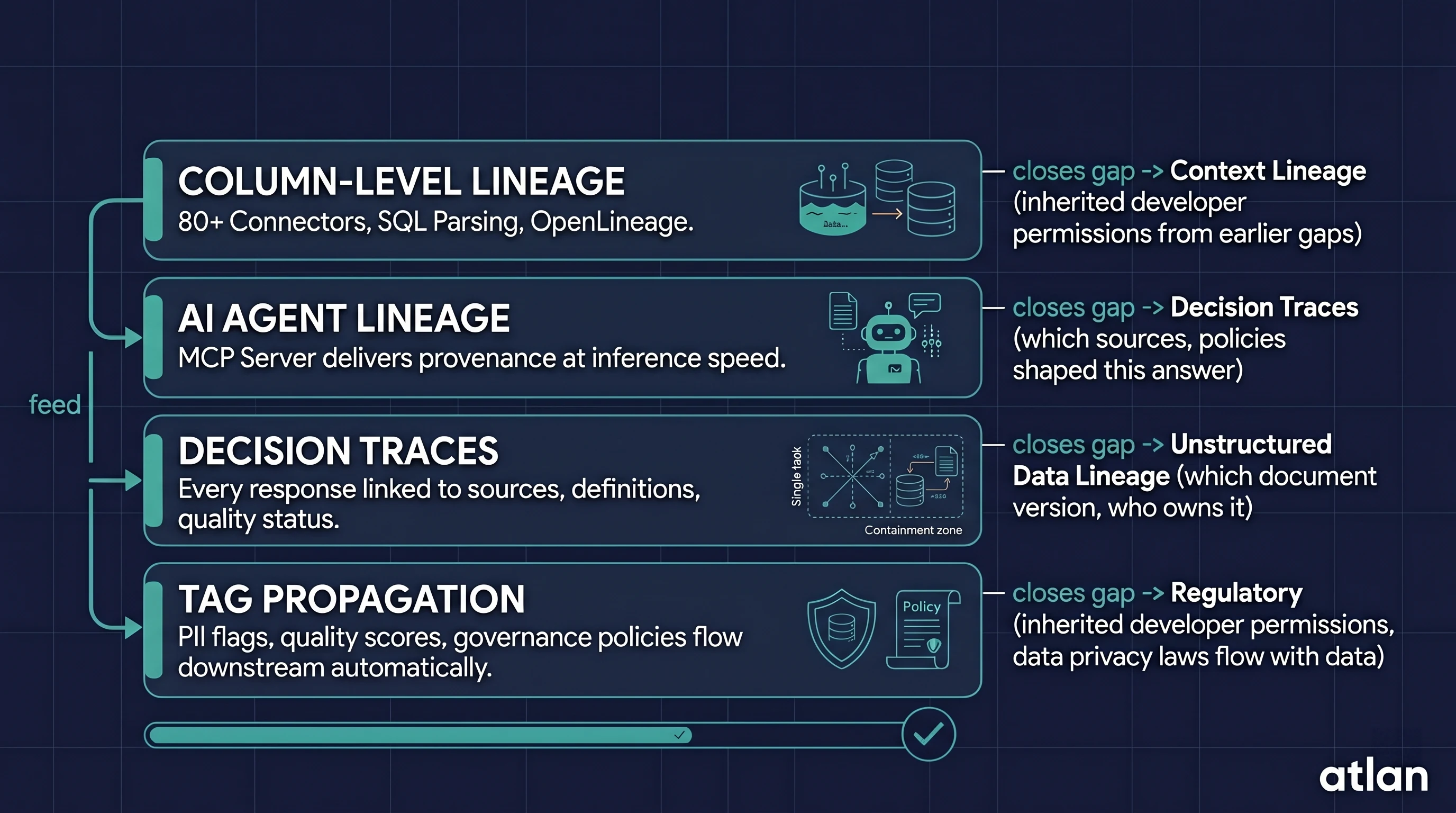
AI data lineage framework showing column-level lineage, AI agent lineage, decision traces, and governance signals across enterprise data dependencies. (Source: Atlan)
AWS’s Responsible AI guidance classifies missing dataset-governance procedures as a high-risk condition and recommends documenting the full data journey, including when data changes and which models or evaluations use it. AWS Responsible AI dataset governance guidance
The technology market is reflecting the same shift. Databricks’ 2026 lineage capabilities now connect foundation models and model services to downstream assets, allowing teams to identify workloads affected before a model or provider is changed. Databricks model and AI service lineage
The implication for enterprises is broader than AI governance. Once the same data drives human decisions, automated workflows, and AI actions, lineage becomes an operational dependency map.
Enterprise Data Lineage Must Extend Beyond the Data Layer
That dependency map loses much of its value if it ends at the warehouse.
Real enterprise data moves through ERP and CRM systems, custom applications, APIs, integration layers, databases, transformation pipelines, BI tools, and increasingly AI services. Some parts of that journey may sit on modern cloud platforms; others may remain inside legacy or internally developed systems.
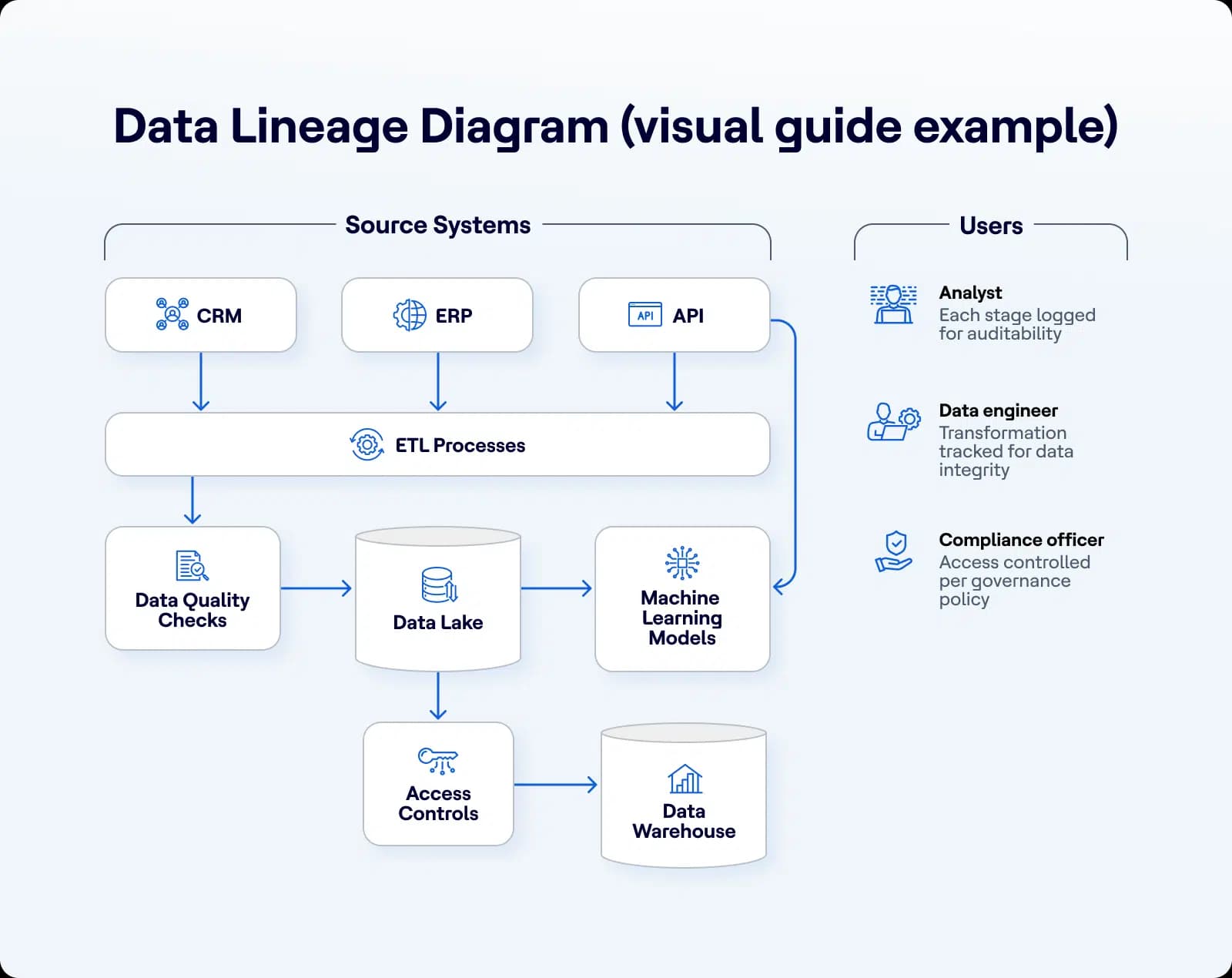
Enterprise data lineage diagram showing CRM, ERP, and API source systems flowing through ETL processes into a data lake, machine learning models, access controls, and a data warehouse. (Source: Actian)
The challenge is therefore larger than selecting a data lineage tool.
Enterprises need to maintain meaningful relationships between technical data flows and the business processes that depend on them. A lineage graph showing that Table A feeds Table B may be technically correct, yet still leave an operations leader unable to see that Table B determines a fulfillment workflow or an AI agent’s recommendation.
This is why end-to-end lineage increasingly needs to connect three levels of dependency: the business system where data originates, the pipeline through which it is transformed, and the report, workflow, application, or AI output that ultimately consumes it.
This is also where Twendee’s deployment approach fits naturally. When connecting ERP, CRM, databases, and internal applications, the objective is not simply to move data between systems. Mapping those flows, adding traceability at critical integration points, and identifying which downstream operations depend on upstream information gives enterprises a clearer way to manage future change.
For AI deployments, that foundation becomes even more useful. Teams can understand where operational context originates before it reaches an agent and determine which workflows or outputs may need review when the underlying source changes.
A technically connected enterprise is useful. A traceable one is much easier to change safely.
Conclusion
As data is reused across reporting, automation, and AI, hidden dependencies become an operational risk. Strong enterprise data lineage makes those relationships visible, allowing teams to understand where business data came from, how it changed, and what may be affected next.
Twendee helps enterprises map cross-system data flows, strengthen traceability, and prepare existing infrastructure for reliable automation and AI deployment.
Visit the Twendee website, follow Twendee on LinkedIn, or book a conversation through Twendee’s Calendly to discuss your enterprise data and AI deployment with Twendee
