
Most organizations already know a great deal about their people. They have CVs, employee records, certifications, project histories and role requirements. Individuals have their own version of the same information across resumes, learning records and career profiles.
The difficulty begins when that information has to support a decision.
Who is ready for this project? How close is someone to a target role? Which capability gaps actually matter? What should be developed first?
CandiVision helps answer those questions by assessing current readiness against a defined goal, identifying what is missing and turning that assessment into clearer development priorities.
AI Readiness Assessment That Shows What to Do Next
A useful readiness assessment needs to produce more than a general description of someone's strengths and weaknesses.
Consider a simple example. A company is preparing a team for a new client project. The role requires eight core capabilities, relevant industry experience and two professional certifications.
One employee may already meet six of the eight capability requirements and hold both certifications, but have limited experience in the client's industry. Another may have stronger domain experience but be missing a technical requirement.
Both profiles could look suitable at first glance. The important question is where each person stands relative to the actual project.
CandiVision is designed to make that comparison clearer.
The platform can assess how closely a profile aligns with a particular position, project or opportunity, then identify gaps across skills, experience and certifications. It can also recommend areas to prioritize, support AI-based interview practice where relevant and track changes in readiness over time. CandiVision Landing Page
The practical output can be understood through four questions:
What already matches the goal?
The user can see which existing capabilities or qualifications are relevant to the target.
What is still missing?
Gaps become specific. The issue may be a technical skill, a certification, relevant experience or another requirement tied to the opportunity.
What deserves attention first?
A long list of possible improvements is rarely useful. Development becomes more actionable when the user can focus on the gaps that matter for the current goal.
Has readiness changed?
As new skills, experience or qualifications are added, progress can be reviewed against the same target.
This is where CandiVision becomes more useful than a static profile review. The result is connected to a decision that someone is actually trying to make.
For a manager, that may be whether an employee is ready for a project now or needs targeted development first.
For an individual, it may be deciding whether the next six months should be spent gaining experience, completing a certification or preparing for interviews.
For a student, it may be understanding what still stands between their current profile and a career path they want to pursue.
How CandiVision Supports Readiness Across Work, Career and Education
CandiVision applies the same core logic across three different contexts: businesses, individuals and education.
The goal changes. The value of seeing current readiness, relevant gaps and next priorities remains.
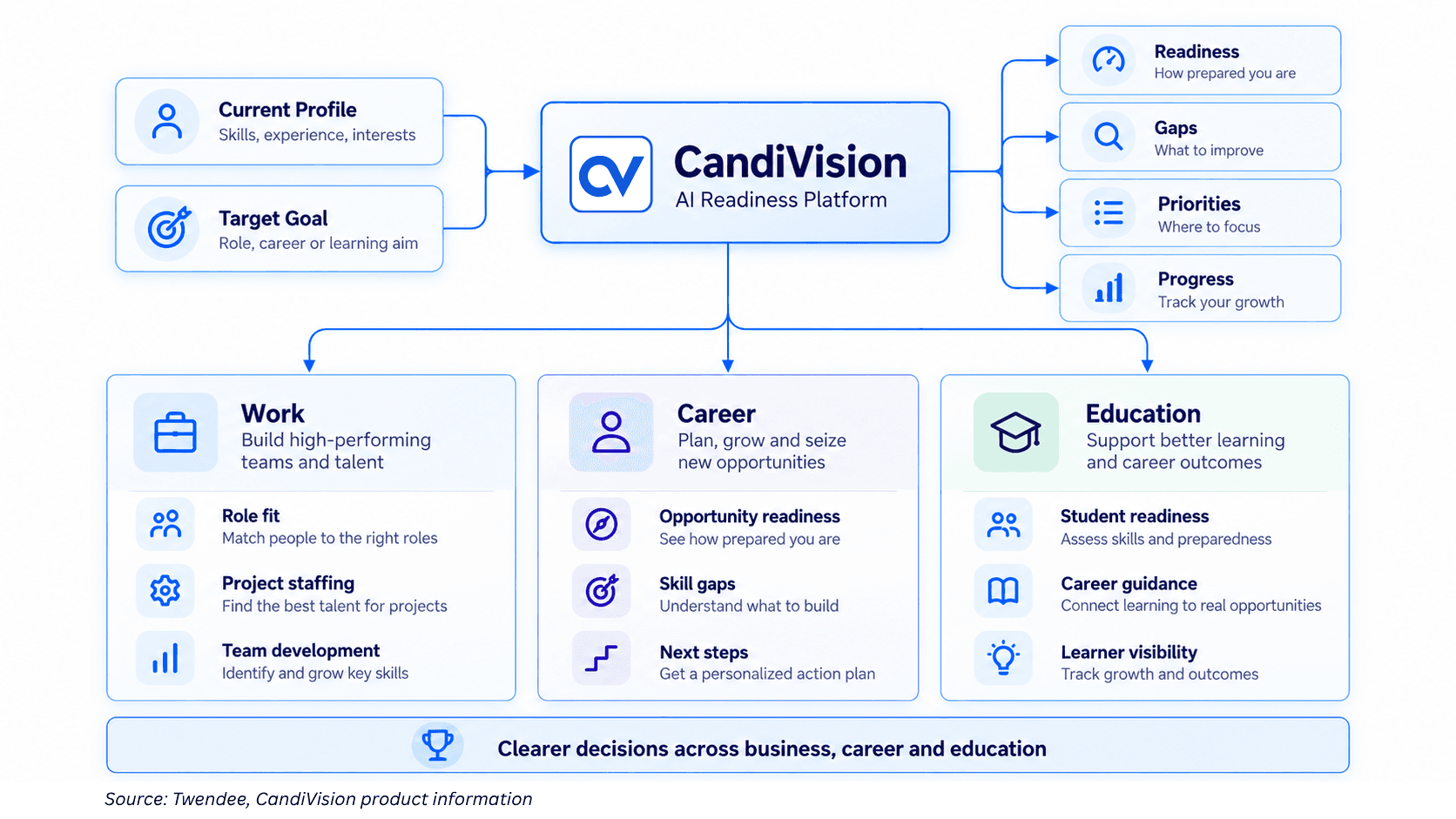
How CandiVision connects current profiles and target goals to readiness insights, development priorities, and progress across work, career, and education. (Source: Twendee)
1. Businesses: make talent decisions with more context
Many workforce decisions happen under time pressure.
A project needs staffing. A position opens internally. A manager needs to identify employees who could take on greater responsibility.
The company may already have the necessary information, but it often sits across different records and is difficult to evaluate consistently against a specific opportunity.
CandiVision helps businesses compare employee profiles with the requirements of a role or project, identify gaps in skills, experience or certifications, support resource allocation and create development paths around actual needs. CandiVision Landing Page
Take a professional services company with 20 people potentially available for an upcoming project.
The immediate goal is not to produce a broad ranking of employees. It is to understand which profiles align most closely with this project and what separates the remaining candidates from being ready.
An illustrative assessment might reveal that one person already meets most technical and certification requirements but lacks sector experience. Another may have worked extensively in the sector but needs one additional technical capability.
That information supports two decisions at once.
The company has more context for the current staffing decision, while employees who are not selected receive a clearer indication of what could improve their readiness for future opportunities.
The second outcome matters. Matching people to opportunities is only one part of workforce planning. Organizations also need to understand how people can become suitable for opportunities they are not ready for yet.
2. Individuals: replace broad career advice with specific priorities
Career development becomes difficult when every possible improvement appears equally important.
Someone targeting a new role might see ten requirements in a job description. They may already meet seven, partially meet two and lack one completely. Without comparing those requirements against their own profile, it is easy to spend time improving an area that has little influence on the immediate goal.
CandiVision helps individuals assess their readiness for specific opportunities, identify capability gaps and receive recommendations around skills, experience or qualifications that may need further development. The platform can also track progress as the user's profile changes. CandiVision Landing Page
The output gives the user a more concrete starting point.
Instead of asking, "What skill should I learn next?", the question becomes more useful:
What is preventing me from being better prepared for this opportunity?
For one person, the answer may be practical experience.
For another, it could be a qualification that appears repeatedly across their target roles.
Someone else may already have the required background and benefit more from interview preparation.
The goal is the same, but the next step should reflect where the individual actually stands.
3. Education: make future readiness easier to see
Students often have even less visibility into readiness because the transition from education to employment involves requirements that extend beyond academic results.
A student may perform strongly in a degree program and still need additional practical experience, professional skills or interview preparation before pursuing a particular opportunity.
CandiVision can help students assess their fit with educational or career goals, identify areas for development and prepare for future applications and interviews. Educational institutions can also gain better visibility into learner readiness. CandiVision Landing Page
That visibility can be useful at more than one level.
For the student, it creates a clearer development direction.
For the institution, repeated gaps across learners can point to areas where additional support may be useful, whether through career services, practical learning opportunities or other development initiatives.
The individual assessment remains important, but the wider value lies in connecting learning with a clearer view of what students may need next.
From Skills Gap Analysis to Actionable Development
Finding a gap is relatively easy. Deciding what to do with it is where the assessment becomes useful.
Imagine an employee being considered for a data project in financial services.
The project requires strong data engineering capability, cloud experience, knowledge of financial operations and a specific certification.
The employee already has the technical foundation and cloud experience. The assessment identifies two areas that need attention: limited financial-services exposure and the missing certification.
That is a much more useful output than a generic statement that the employee needs "more development."
It gives the organization several concrete options.
The employee might complete the certification before the project begins. They could be assigned to a smaller internal initiative that provides relevant domain exposure. The company might decide that another employee is more suitable for the immediate project while using the identified gaps to prepare this person for the next one.
For an individual, the same type of insight could prevent unnecessary learning.
Someone may initially assume they need another technical course, while the assessment shows that their larger gap is relevant work experience.
For a student, the finding may show that academic knowledge is already strong enough and that practical exposure deserves greater attention before graduation.
CandiVision connects these decisions through a simple progression:
Goal → Current readiness → Relevant gap → Development priority → Next action → Progress
The value is in keeping those elements connected.
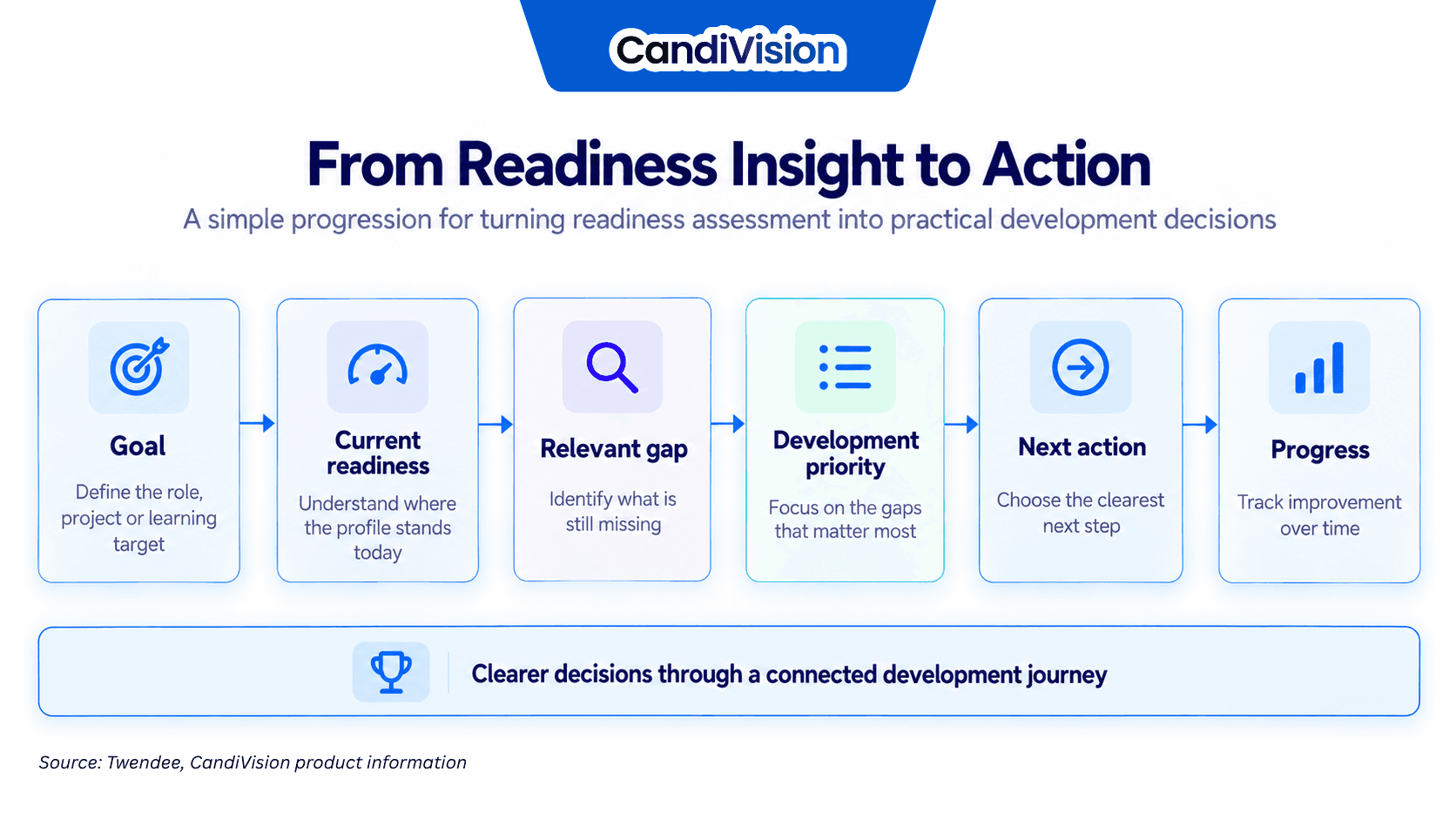
CandiVision turns readiness assessment into a clearer path for development, helping users focus on the gaps that matter and move toward the next meaningful action. (Source: Twendee)
Without a target, a skills gap has little context.
Without prioritization, the user is left with another list of things they could improve.
Without progress tracking, it becomes difficult to see whether development is actually moving someone closer to the outcome they want.
CandiVision's current product direction brings these stages into the same experience, from fit assessment and gap analysis through development recommendations, interview preparation and progress tracking. CandiVision Landing Page
Deploying CandiVision With Twendee
For organizations, the usefulness of CandiVision will depend on the problem it is introduced to solve.
A technology company looking to improve project staffing does not need the same setup as a university helping students prepare for employment. A talent development team may also use readiness information differently from a recruitment or resource management team.
This is the focus of the strategic partnership between CandiVision and Twendee.
Twendee works alongside CandiVision to help organizations turn the platform into practical value, starting with a clear use case and continuing through deployment, adoption and longer-term expansion.
The process begins by defining the decision the organization wants CandiVision to support.
For example:
Which employees are ready for upcoming projects?
Where are the most relevant capability gaps across a team?
How can development plans be connected more closely to future roles?
How can students receive clearer guidance before entering the job market?
Once that use case is clear, Twendee supports the organization in shaping an appropriate deployment approach based on its users, scale and objectives. The partnership also covers onboarding, adoption and continued support as real-world feedback reveals where the platform can create further value. CandiVision Landing Page
This approach keeps the implementation grounded in an actual operational or development need.
Organizations do not need another assessment simply because more data can be generated. They need outputs that help someone make a clearer decision and a deployment model that allows those outputs to become part of how people already work.
Conclusion
CandiVision gives readiness a practical reference point: a real role, project, learning goal or opportunity.
From there, businesses, individuals and educational institutions can see what is already in place, where meaningful gaps remain and which areas deserve attention next.
That makes the output useful beyond assessment itself. It can inform staffing decisions, career development, learning priorities and preparation for future opportunities.
For organizations looking to apply CandiVision to a specific use case, Twendee supports the path from defining the need to deployment, adoption and broader use over time.
Discover more about CandiVision.
Learn more about Twendee and sign up for a free trial of CandiVision here.
