

Enterprise automation is accelerating, yet the systems underneath it remain fragmented. MuleSoft’s 2026 Connectivity Benchmark Report reports that the average organization manages 957 applications, while only 27% are connected; 82% of IT leaders also cite data integration as a major challenge in using AI. For leaders investing in enterprise API integration, ERP CRM integration, system integration, and application integration architecture, the issue is becoming architectural: automation can scale only as fast as the interfaces it depends on.
Automation Breaks When Enterprise Systems Cannot Reliably Communicate
Most enterprise workflows cross several systems before any automation is added. A customer order may begin in a commerce platform, move through CRM, trigger inventory updates in ERP, create a finance record, and eventually feed service operations. Each handoff assumes that the next system understands the same customer, transaction, status, permission, and timing.
That assumption is often fragile.
MuleSoft’s 2026 benchmark found that 71% of respondents believe their IT infrastructure makes systems overly dependent on one another. Automation makes that dependency visible. A delayed ERP update can produce the wrong inventory status. A CRM field change can stop a downstream process. An AI agent may reach the correct decision and still fail to execute because the system of record rejects the request or returns data in an unexpected format.
This is why automation can look successful in a controlled pilot and become unstable in production. The workflow logic may be sound; the failure occurs at the boundaries between applications.
For executives, that changes the question from “What can we automate?” to “Which system interactions can we rely on repeatedly?” The bottleneck in enterprise automation is often the infrastructure connecting the systems underneath it.
Every New Automation Increases the Cost of Weak Integration
A single workflow can tolerate integration debt. Teams add scripts, manual exception handling, custom transformations, or one-off point-to-point connections to keep it moving. The cost becomes harder to ignore when the same architecture supports dozens or hundreds of workflows.
Postman’s 2024 State of the API Report found that the average application is powered by 26 to 50 APIs. Automation increases the frequency with which those interfaces are exercised. Every new workflow introduces additional calls, dependencies, failure paths, and coordination requirements.
Consider order-to-cash across commerce, ERP and finance, or an AI agent that reads enterprise data and triggers a business action. Each flow may work independently. Together, they create a dense network in which one system change can affect many downstream processes.
This is how integration debt turns into automation debt. The organization spends more time maintaining transformations, reconciling errors, retesting dependencies, and coordinating releases. Automation multiplies the number of times existing complexity is tested.
The strategic risk is how quickly the cost of change grows as automation expands. Once workflows are tightly coupled to the internal structure of ERP, CRM, finance, or operations platforms, each major system change can become an enterprise-wide integration project.
Stable Interfaces Are the Foundation of Scalable Enterprise Automation
A stable interface should be treated as a contract between systems. It defines what one application can expect from another even while the implementation behind that interface evolves.
Microsoft’s Azure Architecture Center API design guidance makes this principle explicit: APIs serve as contracts between services and consumers, and changes should remain backward compatible where possible so dependent applications continue to work. That matters in enterprise integration, where the consumers are often business-critical workflows.
In practice, stability requires clarity around three areas:
Data: which objects and fields are exchanged, their format, and which system owns them.
Behavior: how requests are processed, how errors are returned, and what consumers can safely expect.
Control: who or what can access the interface, which actions are permitted, and how changes are versioned.
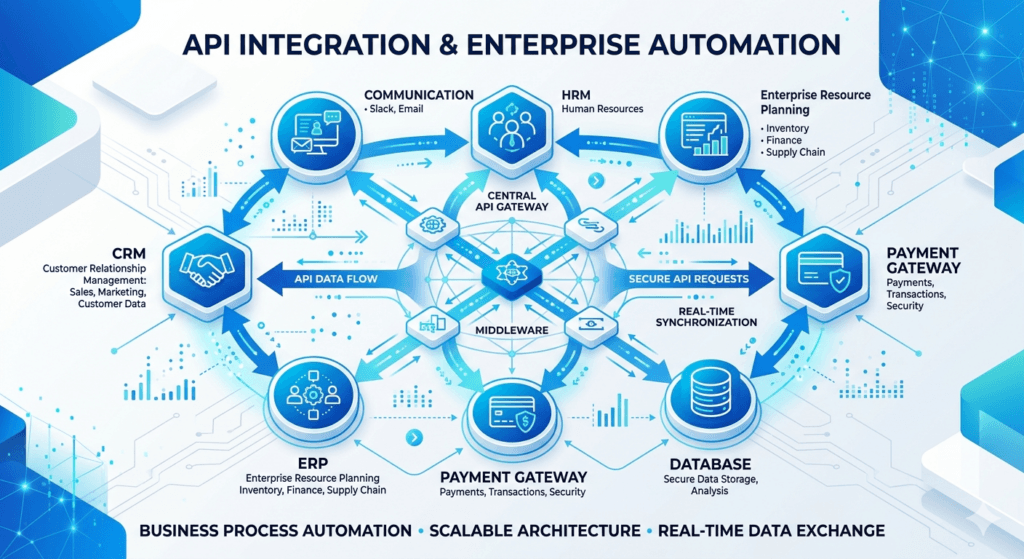
Enterprise API integration architecture connecting CRM, ERP, HRM, databases and payment systems through a central API gateway and middleware. (Source: melihsamur)
These decisions determine how independently systems can evolve. If CRM changes its internal customer schema, downstream automation should continue to consume a stable customer contract. If an ERP workflow is upgraded, the integration layer should absorb most of that change rather than forcing every connected process to be rewritten.
This is also where an API gateway and related integration controls become valuable. Routing, authentication, rate limits, observability, policy enforcement, and version management create a managed boundary around core systems. Microsoft’s Well-Architected guidance similarly treats authentication, authorization, backend abstraction, versioning, and API change management as architectural concerns rather than isolated implementation details.
Scalable automation depends less on how quickly teams can build another workflow and more on how reliably those workflows can interact with core systems over time.
A Strong API Strategy Is Designed for Change, Not Just Connectivity
The strongest API strategies are judged by what happens after the initial integration works.
Enterprise systems rarely stand still. ERP platforms are upgraded, CRM products are migrated, finance systems are consolidated, acquisitions introduce new applications, and AI tools create new consumers of existing data. A strategy focused on connecting system A to system B solves the immediate project while leaving future change expensive.
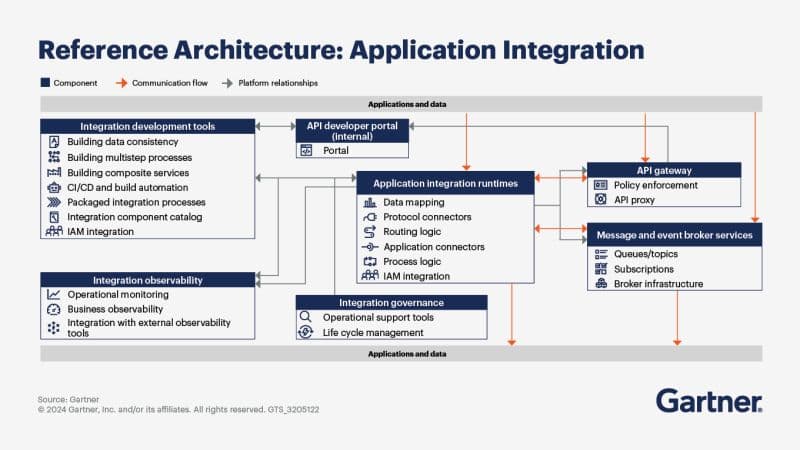
Gartner reference architecture for enterprise application integration showing API gateways, integration runtimes, governance, observability and message broker services. (Source: Gartner)
Microsoft recommends versioning when breaking API changes are unavoidable and supporting existing contracts while consumers migrate. The business implication is straightforward: a core system should be able to change without forcing every connected workflow to change at the same time.
Invesco provides a useful example. The asset manager was dealing with more than 200 siloed IT systems and needed faster access to customer and market data. According to MuleSoft’s Invesco case study, Invesco adopted an API-led model, integrated more than 44 systems, and built more than 89 APIs in 12 months. Development time fell by 92%, while prospective customer inquiries reached sales teams 40% faster.
The deeper lesson is reuse. APIs turned access to core data into reusable capabilities instead of repeated project-specific connections. New workflows could consume established interfaces rather than rebuilding access to the same systems.
A useful executive test follows: if one core application changes tomorrow, how many workflows have to change with it? The smaller that blast radius, the stronger the API strategy.
Build the Integration Layer Before Scaling Automation and AI
Enterprises do not need to modernize every legacy platform before pursuing automation. They do need a reliable layer between those platforms and the automation being built above them.
The sequence matters: core systems expose governed, stable interfaces; an integration layer manages exchange, permissions, routing, errors, and change; automation operates against those contracts; AI-enabled workflows gain controlled access to enterprise data and actions.
This is the approach Twendee applies when designing API integration between ERP, CRM, finance, and internal systems. The work starts with identifying where business data lives, which system owns each process, and how workflows cross application boundaries. Secure data flows and interface layers can then be designed so new automation does not depend directly on the internal structure of every system it touches.
That separation creates room for change. A business can introduce a new AI agent, replace a CRM module, or add an operational workflow without rebuilding the entire integration path. Governance teams also gain clearer points to enforce permissions, monitor failures, and control which systems can trigger business actions.
For organizations moving from isolated automation pilots toward enterprise-scale AI, the integration layer is increasingly part of the operating architecture.
Conclusion
API strategy becomes strategic when automation begins to depend on it. Stable interfaces reduce the blast radius of system change, make automation more reusable, and give AI workflows a controlled way to interact with core applications.
The goal is an architecture that can keep adding automation without becoming harder to change. Twendee helps enterprises design and build that foundation across ERP, CRM, internal systems, and AI-enabled workflows. If your automation roadmap is starting to expose integration constraints, visit the Twendee website, follow Twendee on LinkedIn, or book a conversation through Twendee’s Calendly to identify where a more stable interface layer can unlock the next stage of scale.
