

Enterprise APIs rarely live in one clean catalog. They accumulate across cloud platforms, SaaS integrations, mobile applications, internal services and partner connections. Some remain well documented. Others outlive their owners, bypass approved gateways or continue running after a replacement launches. API discovery gives enterprises a current view of that estate. Its real value comes from connecting each live API to ownership, usage, data exposure and lifecycle decisions. As AI agents create another class of machine consumers, that operational visibility is becoming essential.
The API Estate Is Usually Larger Than the Catalog
API growth is accelerating faster than many governance processes can follow. The H1 2026 State of AI and API Security report from Salt Security found rapid expansion. In 66% of surveyed organizations, API numbers had increased by more than 50% during the previous year. Nearly 90% were already using or planning to use generative AI in API development.
Every new digital workflow can add more interfaces. A customer journey may call identity, payment, CRM and analytics APIs. Internal automation connects ERP, HR and finance platforms. SaaS tools create webhooks and service accounts. AI-connected services introduce APIs that retrieve data or trigger actions for agents. The estate expands through many teams, budgets and deployment environments.
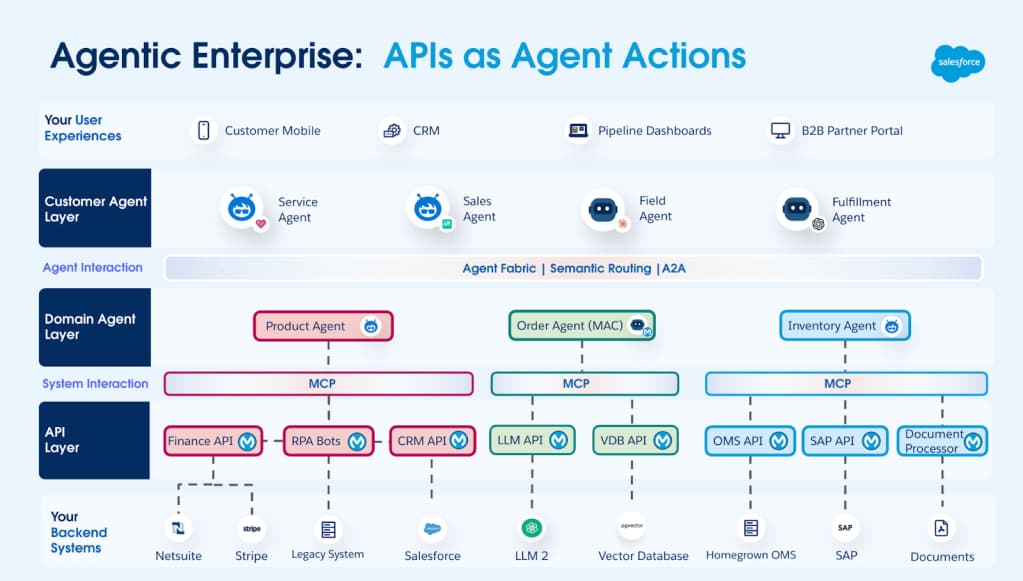
AI agents add a new layer of API consumers across enterprise applications and backend systems. (Source: MuleSoft)
Documentation captures what teams intended to build. Production traffic reveals what is actually running. The difference includes shadow APIs created outside the approved process and deprecated versions that still receive traffic. It also includes forgotten test hosts, duplicate services and endpoints owned by former teams.
This gap is measurable. Cloudflare's State of Application Security report found a median of 33% more REST endpoints through machine-learning-based API discovery than customer-provided session identifiers revealed. A declared list can therefore create confidence while leaving a meaningful share of the attack surface outside it.
Unknown endpoints also create operational friction. Developers rebuild capabilities because they cannot find an existing service. Integration teams depend on an old version because no migration owner was assigned. Security teams investigate incidents without knowing every route that reaches the affected data. Maintenance spending continues because nobody can confirm whether a legacy API still has consumers.
An API inventory needs to reflect the deployed estate, including internal, partner and public interfaces. Otherwise, API management covers the most visible assets while risk collects around the least visible ones.
API Discovery Creates Value When the Inventory Drives Action
API discovery is the process of finding APIs from real enterprise evidence. That evidence can include gateway and load-balancer traffic, application logs, cloud configurations, service meshes, code repositories, API specifications and integration platforms. Each source shows a different part of the estate.
Runtime traffic can reveal undocumented endpoints and active consumers. It may miss a dormant API that becomes critical at month-end. Repository scanning finds definitions before deployment, yet it may also include abandoned code. Gateway catalogs offer rich policy data for managed traffic while overlooking services that bypass the gateway. Effective API discovery tools correlate several sources, remove duplicates and preserve where each finding came from.
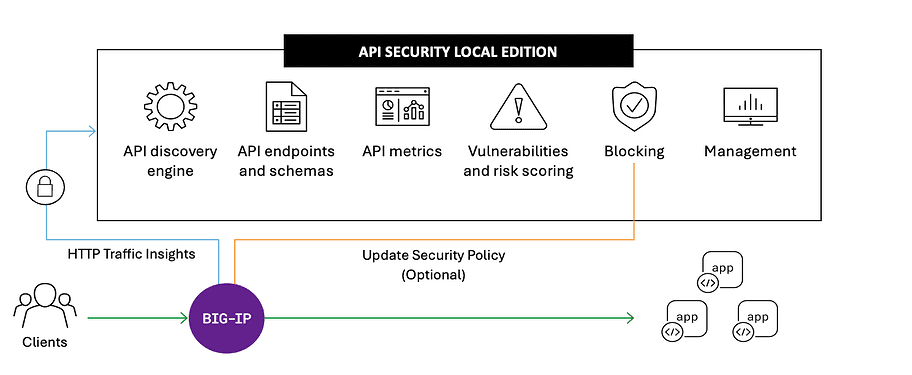
Traffic-based API discovery can turn observed requests into endpoint visibility, risk scoring and security actions. (Source: DevCentral)
Discovery produces candidates. A structured API inventory turns those findings into decisions. Each API record should answer a small set of practical questions:
Who owns it? Record the accountable product or platform team and a current escalation path.
Where does it run? Capture host, version, environment and whether access is public, partner-facing or internal.
What does it expose? Classify the data returned and the business actions the API can perform.
What depends on it? Identify applications, partners, automations and AI agents that consume it.
What is its status? Mark the API as experimental, active, deprecated or scheduled for retirement, with a review date.
These fields separate an operational inventory from a count of endpoints. The distinction is visible in Akamai's 2026 API Security Impact Study. Seventy-seven percent of respondents reported having a full API inventory. Only 23% had that inventory and knew which APIs returned sensitive data. The organizations experienced an average of 3.5 API-related security incidents over 12 months. Their average combined cost reached about US$700,000.
Once the inventory contains context, it can support several workflows. Security teams can prioritize an internet-facing API that returns customer records above an internal endpoint with limited data. Incident responders can identify connected applications and owners without starting a company-wide search. Architects can see which services duplicate existing capabilities. Procurement teams can document third-party API dependencies before a vendor change disrupts a critical process.
Lifecycle decisions become clearer as well. A deprecated API with no traffic for 90 days may be a retirement candidate. One with two active consumers needs a migration plan. A legacy endpoint that handles sensitive data without approved authentication may require immediate containment and modernization. The inventory supplies the evidence for each decision and records who accepted any temporary exception.
This is also why discovery should connect with delivery workflows. A new API specification can create an inventory record during CI/CD. Deployment metadata can confirm the environment and version. Runtime monitoring can add traffic, consumer and last-seen data. Security checks can flag unexpected exposure or missing authentication. A change in ownership or lifecycle state should trigger review rather than wait for the next annual audit.
The OWASP API Security Top 10 identifies improper inventory management as a distinct risk. OWASP recommends inventorying API hosts, deployed versions, access expectations and integrated services. It also calls for documentation generated through open standards and included in CI/CD. Its illustrative example shows why: a forgotten beta API lacked the rate limiting applied to the official host, allowing password-reset tokens to be brute-forced.
Teams should measure whether API discovery improves control. Useful indicators include ownership coverage, data classification coverage and time from detection to review. Teams can also track deprecated APIs with active traffic and retirement plans completed on schedule. These measures reveal whether the inventory is changing behavior or simply growing as a database.
Continuous Discovery Supports Safer Integration and Modernization
A one-time scan creates a snapshot. Enterprise API estates change whenever a team releases a service, a vendor adds an integration or an AI workflow gains permission to call another system. Continuous API discovery compares those changes with the approved inventory and surfaces drift while the context is still fresh.
The process needs clear ownership. Platform teams can maintain discovery coverage and standards. Product teams confirm business purpose and consumers. Security teams define exposure and authentication requirements. Architecture or integration leaders decide when duplicate and aging interfaces should be consolidated. Shared data allows these groups to work from the same API record instead of separate spreadsheets.
Twendee can help enterprises discover and document APIs across cloud, SaaS and internal systems, then structure the findings around ownership, lifecycle and integration metadata. We connect the API inventory with delivery, security and modernization workflows. That creates a practical path for migrating active consumers, improving controls around high-risk endpoints and retiring APIs that add maintenance cost without supporting current operations.
Adoption can begin with one business-critical domain, such as payments, customer data or order management. Teams can combine traffic evidence with repository and gateway data, validate owners and classify exposure. The resulting workflow can then expand to other domains. This builds an API inventory that becomes more accurate as integrations change, rather than less useful with every new release.
Conclusion
API discovery is becoming essential because enterprise integration now extends across cloud platforms, SaaS tools, custom applications and AI-connected services. Finding an endpoint is only the starting point. A useful inventory connects every API with its owner, consumers, data exposure and lifecycle status, then feeds security, delivery and modernization decisions. Continuous visibility reduces shadow API risk and speeds up incident response. It also helps enterprises retire aging interfaces with fewer surprises for the systems that still depend on them.
Book a call: Calendly
Read our latest blog: Event-Driven Architecture: When Enterprise Systems Need Real-Time Integration
